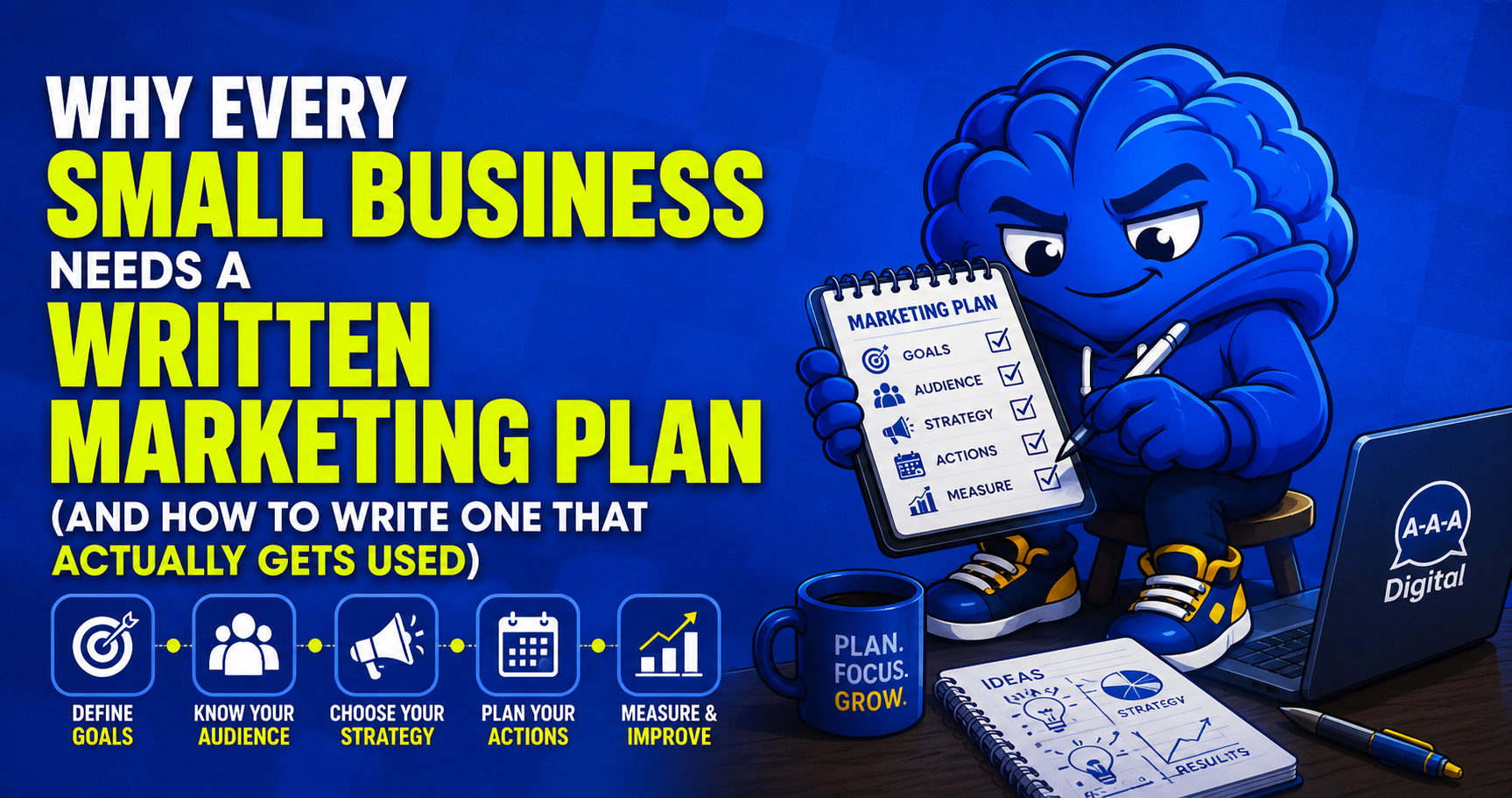
I have sat across from dozens of small business owners in London who spent more time choosing a holiday campaign creative than planning where that creative would run, who would see it, and what they wanted those people to do next.
That is not a criticism. Small business owners are stretched. They handle sales, operations, hiring, inventory, and sometimes delivery. Marketing becomes a series of reactions. A seasonal offer here. A boosted post there. A flyer because the competitor put one up. The result is predictable: money goes out, but revenue does not move in any clear direction.
A written marketing plan fixes this. Not because the document itself is magical, but because the act of writing it forces clarity.
What a Marketing Plan Is Not
Let me get this out of the way first.
A marketing plan is not a fifty-page deck full of buzzwords. It is not a mission statement printed in Helvetica. It is not a forecast pulled out of thin air to impress an investor.
It is a practical document that answers a short list of questions:
- Who exactly are we trying to reach?
- What do they already believe about the problem we solve?
- What do we want them to do?
- Where will we reach them?
- What will we say?
- How much will we spend?
- How will we know if it worked?
If your plan does not answer those questions in plain language, it is not a plan. It is a wish.
Why Small Businesses Skip Planning
There are usually three reasons.
They are too busy. This is real. When you are running a business, planning feels like a luxury. But operating without a plan is what creates the chaos that makes you busy in the first place.
They do not know how. No one taught them. They learned marketing by watching competitors and reading half-finished articles online. Planning sounds like something only big companies do.
They are afraid of being wrong. A plan forces you to commit to assumptions. What if the assumption is wrong? Here is the truth: it probably will be. But a written plan makes it easier to spot the wrong assumption early and adjust. Without a plan, you just keep spending.
The One-Page Marketing Plan Template
We use a simplified version of this with every small business client at AAA Digital. It fits on one page. If you cannot fit it on one page, you are overcomplicating it.
1. Business Goal
What is the one thing marketing needs to drive in the next ninety days? Not five things. One.
Examples:
- Increase monthly recurring revenue by twenty percent
- Generate fifty qualified leads for the sales team
- Drive two hundred store visits in the next quarter
- Clear old inventory worth ten thousand pounds
The goal determines everything else. A brand awareness campaign looks very different from a lead generation campaign.
2. Target Customer
Describe one ideal customer. Not a demographic blob like "women aged 25–45." A real person with a real problem.
For example:
Priya runs a boutique in Shoreditch. She has been in business for three years. She wants to expand online but does not understand Instagram ads. She has tried two agencies and felt burned. She values transparency and examples more than low prices.
When you know Priya, your messaging writes itself. When you target "women 25–45," you end up with generic ads that appeal to no one.
3. Core Message
What do you want your target customer to believe about you?
This is not a tagline. It is the single idea that should run through every piece of marketing. For a local bakery, it might be: "We use real butter and bake fresh every morning, even if it costs more." For a B2B consultant, it might be: "We fix the tracking and attribution problems that make ad spend invisible."
Your core message should pass the competitor swap test. If your competitor could use the exact same sentence, it is not a core message. It is a platitude.
4. Channels
Where will you show up? Pick two or three primary channels. Not seven.
For most small businesses, the best starting mix is:
- One owned channel: email, SMS, or WhatsApp
- One organic channel: Google Business Profile, Instagram, or SEO
- One paid channel: Meta Ads, Google Ads, or local listings
The exact choice depends on where your customer already spends attention and money.
5. Budget
Write down a number. Then split it into three buckets: sixty percent for proven activities, thirty percent for testing, ten percent for emergency opportunistic spends.
The sixty-thirty-ten split keeps you from blowing the entire budget on unproven ideas while still leaving room to experiment.
6. Content and Campaign Calendar
List the next four to six weeks of activity. What offers? What content? What ads? What emails? When?
This is where most small businesses fall apart. They post when they feel like it. A calendar makes marketing a recurring system instead of a creative impulse.
7. Success Metrics
Pick three numbers. No more.
For example:
- Cost per lead
- Lead-to-customer conversion rate
- Customer acquisition cost
Measure them weekly. If a number is moving in the wrong direction for two weeks, investigate. If it moves in the wrong direction for four weeks, change the plan.
How Often Should You Update the Plan?
A marketing plan is a living document. We recommend reviewing it every month and rewriting it every quarter.
Monthly review: Are we on budget? Are metrics moving? Is the calendar being followed?
Quarterly rewrite: Are our assumptions still true? Has the competitive landscape changed? Do we need to shift channels?
The quarterly rewrite is important because small businesses change fast. A plan written in January may be irrelevant by April.
Common Mistakes in Small Business Marketing Plans
Here are the ones I see most often.
Mistake one: confusing goals with tactics. "Post on Instagram every day" is not a goal. It is a tactic. The goal might be "generate thirty leads a month from Instagram."
Mistake two: ignoring the maths. If your average order value is eighty pounds and your target CAC is thirty pounds, your margin has to support that. Many small businesses set targets without checking if the numbers work.
Mistake three: copying big brands. Big brands can afford awareness campaigns. Small businesses usually cannot. Your plan needs to drive revenue, not impressions.
Mistake four: no clear owner. If everyone owns the plan, no one owns it. Assign one person to execute and one person to review metrics.
Mistake five: set-and-forget. A plan that lives in a drawer is useless. Schedule the review before you finish writing it.
What Happens When You Actually Use a Marketing Plan
The businesses we work with that stick to a simple marketing plan usually report three things within the first quarter.
First, they spend less. Not because they cut marketing, but because they stop spending on random things that do not fit the plan.
Second, they move faster. Decisions become easier because the plan acts as a filter. Should we sponsor this event? Does it fit the plan? Yes or no.
Third, they sleep better. There is a strange peace that comes from knowing you have a plan, even when the plan needs to change.
A Real-World Example
One of our clients runs a small healthcare clinic in Manhattan. When they came to us, they were running ads occasionally, posting on Facebook when they remembered, and hoping word of mouth would scale.
We wrote a simple ninety-day plan with three priorities:
- Fix Google Business Profile and local SEO so people nearby could find them
- Run a small Google Ads campaign for high-intent keywords like "dermatologist near me"
- Set up a basic email and SMS follow-up system for inquiries
Within four months, local map-pack calls increased by one hundred and forty percent. Cost per appointment dropped by forty-five percent. The owner told me the biggest change was not the numbers. It was that he finally knew where his marketing money was going.
Where to Start Today
If you do not have a marketing plan, do this today.
Open a blank document. Write down your one business goal for the next ninety days. Describe your ideal customer in one paragraph. Write the one message you want them to remember. Pick two channels. Set a budget. List your first four weeks of activity. Choose three metrics.
That is your plan. It will not be perfect. But it will be better than guessing.
Want a marketing plan built specifically for your small business? Book a free strategy call and we will build a ninety-day plan together.