A few months ago I spoke with a financial advisor in London who had spent close to eight thousand pounds on a single hotel ballroom seminar. The venue looked impressive. The refreshments were excellent. Seventy-three people showed up.
Twelve of them filled out a feedback form. Three answered a follow-up call. None became clients.
He told me seminar marketing does not work anymore. I told him his seminar marketing did not work. There is a difference.
When done well, seminars are still one of the highest-trust lead generation channels available. People who give you three hours of their Saturday are warmer than any lead from a cold ad. The problem is that most seminar marketing stops at registration. It does not think about the full journey: attention, registration, attendance, trust, offer, follow-up.
What Seminar Marketing Means Today
Seminar marketing is the use of in-person or virtual events to educate prospects, demonstrate expertise, and convert attendees into customers or clients. It is common in industries where trust and complexity are high: financial services, real estate, education, healthcare, coaching, and B2B consulting.
The format has evolved. A seminar can be:
- A physical workshop in a hotel or co-working space
- A webinar hosted on Zoom or Teams
- A hybrid event with both live and online audiences
- A short masterclass delivered through a private community
- A lunch-and-learn for corporate decision makers
The medium matters less than the structure. A seminar is a trust event. If it does not build trust, it is just an expensive presentation.
Why Seminars Fail
Most seminar failures fall into one of four categories.
Wrong audience. The room is full of people who are curious but not qualified. They came for the free lunch, not because they have a problem you can solve.
Wrong promise. The topic sounds interesting but does not connect to a buying decision. "The Future of Digital Marketing" is vague. "How to Generate Consistent Leads Without Increasing Ad Spend" is specific and purchase-adjacent.
Wrong follow-up. The event ends, attendees leave, and the team waits two days before calling. By then, the emotional momentum is gone.
Wrong economics. The cost per seat is higher than the lifetime value of the clients you are likely to acquire. This usually happens when you over-invest in production and under-invest in targeting.
The Seminar Marketing Funnel
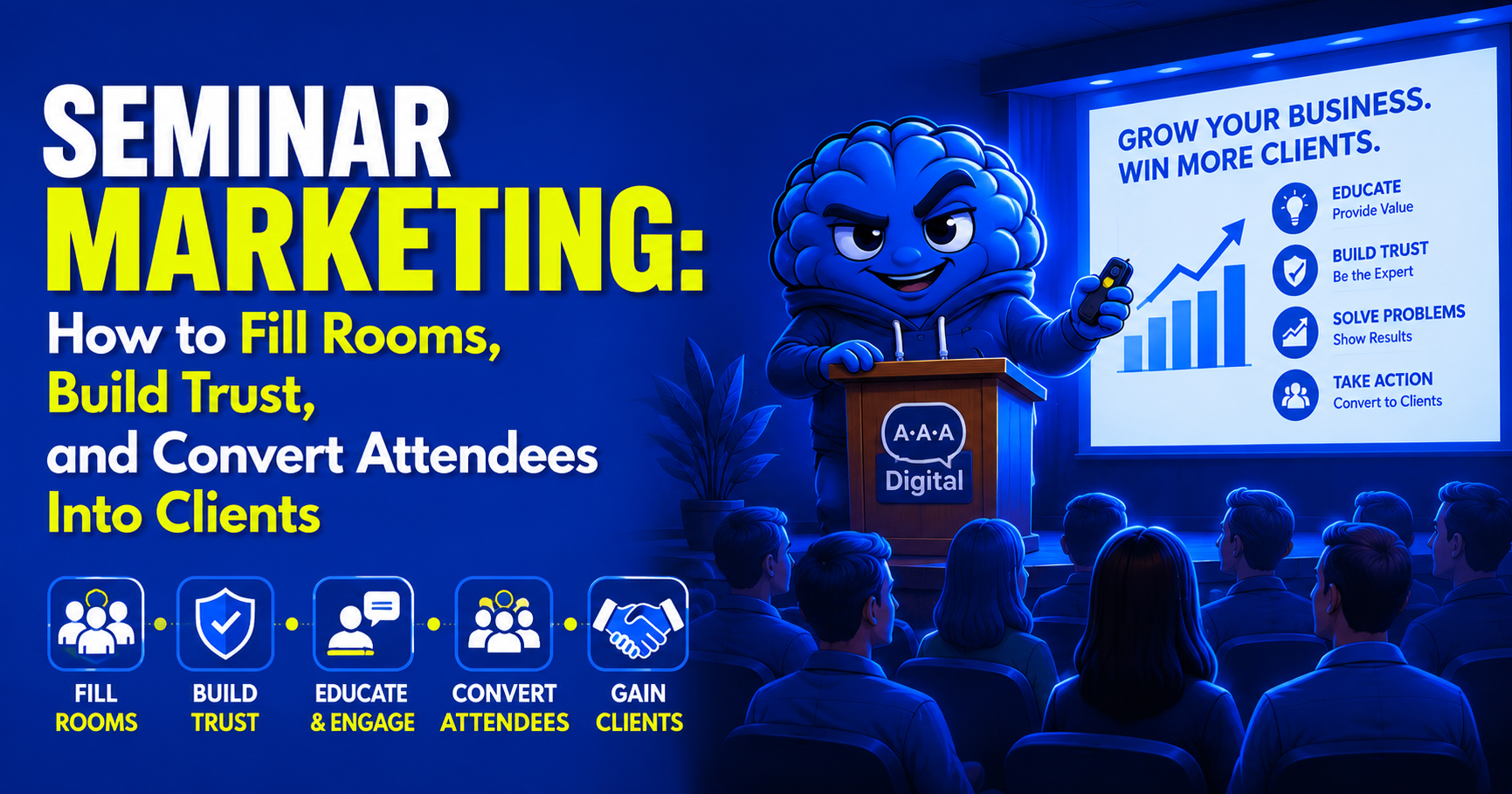
A successful seminar campaign has five stages. Weakness at any one stage breaks the whole system.
Stage 1: Attract the Right People
This starts with the audience list, not the creative. Who has the problem you solve? Where do they live? What do they read? What have they already bought?
For local seminars, targeting often works best through:
- Facebook and Instagram ads with demographic and interest filters
- Google Ads for intent keywords
- Partnerships with local businesses or communities
- Email lists of past prospects and customers
- WhatsApp or SMS broadcasts to existing contacts
The key is to disqualify as much as qualify. Your ad should make it clear who the seminar is for and, just as importantly, who it is not for.
Stage 2: Get the Registration
A registration is not just a name and phone number. It is a micro-commitment. The higher the commitment, the higher the attendance rate.
We usually see better attendance when registrants:
- Pay a nominal refundable fee
- Answer one or two qualifying questions
- Receive a confirmation call within twenty-four hours
- Get a calendar invite immediately
- Receive reminder messages two days, one day, and two hours before the event
Free seminars with no friction often have attendance rates below thirty percent. Seminars with light friction and strong reminders can hit sixty to seventy percent.
Stage 3: Deliver Value Before the Pitch
The seminar itself is a demonstration of your expertise. The content should be genuinely useful even if no one buys. If attendees feel they learned something practical, they will trust you enough to consider the next step.
A good structure:
- Open with the problem and why it matters
- Share a framework or mental model
- Give one or two actionable takeaways
- Show a case study or result
- Make a soft, clear offer
- Explain exactly what to do next
The offer should feel like the natural continuation of the seminar, not a sudden sales ambush.
Stage 4: Capture Intent at the Event
Not everyone will be ready to buy on the spot. Some will need a week. Some will need a month. Your job is to know who is who.
Use a short post-event survey or a one-on-one consultation booking link. Ask attendees to rate their interest. Offer a free audit, assessment, or discovery call. The ones who book are your hot leads. The ones who do not book go into a nurture sequence.
Stage 5: Follow Up Ruthlessly
The money is in the follow-up. Within four hours of the event, send a thank-you message with the recording, slides, and a clear next step. The next day, call every attendee. Not to pitch immediately, but to answer questions and book consultations.
For the next thirty days, run an email or SMS nurture sequence with additional value, social proof, and occasional reminders of the offer.
Virtual Seminars vs In-Person Seminars
Virtual seminars are cheaper to run and easier to scale. In-person seminars build deeper trust and command higher ticket sizes.
We usually recommend virtual seminars for:
- Lower-ticket products or services
- Audiences spread across cities or countries
- Testing topics before investing in physical events
- Building a large top-of-funnel list
We recommend in-person seminars for:
- High-ticket services like financial planning, real estate, or consulting
- Local businesses that rely on community trust
- Industries where personal chemistry matters
- Audiences that prefer face-to-face decision making
Many of our clients run a virtual seminar first, then invite the most engaged attendees to a smaller in-person session.
How to Promote a Seminar Without Wasting Budget
Promotion is where most seminar budgets die. Here is the approach we use at AAA Digital.
Start with a small test. Spend fifteen to twenty percent of your total budget on a pilot campaign. Test two or three audiences, two or three creatives, and two or three headlines.
Double down on what works. When you find a combination that drives registrations below your target cost, scale it. Do not spread the remaining budget evenly across losing variants.
Retarget non-registrants. People who clicked but did not register are your cheapest second chance. Show them a testimonial, a reminder, or a limited seat message.
Use urgency carefully. "Only ten seats left" works once. If you use it every week, it becomes noise. Save urgency for real scarcity.
Track cost per attended seat, not cost per registration. A cheap registration that does not show up is worthless. Attendance rate is the metric that matters.
Measuring Seminar Marketing ROI
The formula is simple but often ignored.
Total seminar cost ÷ number of clients acquired = cost per acquisition
But you also need to track:
- Cost per registration
- Cost per attended seat
- Consultation booking rate
- Consultation-to-client conversion rate
- Average revenue per new client
- Payback period
If your cost per acquisition is lower than the first-year value of a client, the seminar is profitable. If it is not, fix the funnel before running another event.
Final Thought
Seminar marketing is not dead. Lazy seminar marketing is dead. The businesses that treat seminars as integrated trust-building systems — not standalone events — are still filling rooms and closing deals.
The question is not whether seminars work. The question is whether you are willing to build the system around them.
Thinking about running seminars for your business? Book a free strategy call and we will help you design the funnel, creative, and follow-up system.